Artificial intelligence is moving quickly into dentistry.
According to the American Dental Association Health Policy Institute, 43.3% of responding dentists were already using AI for at least one task in their practices by mid-2026, and another 26.4% said they planned to use it in the future. Current adoption is concentrated in areas such as imaging and diagnostics, insurance verification, business analytics, patient communication, and administrative functions.
That matters because dental practices are under real operational pressure. The ADA also reports continuing staffing challenges and notes that 32.4% of dentists surveyed considered themselves overworked. AI, automation, analytics, and improved practice-management systems can therefore create meaningful value by reducing administrative burden and improving efficiency.
But there is an important strategic distinction that practice owners should not overlook:
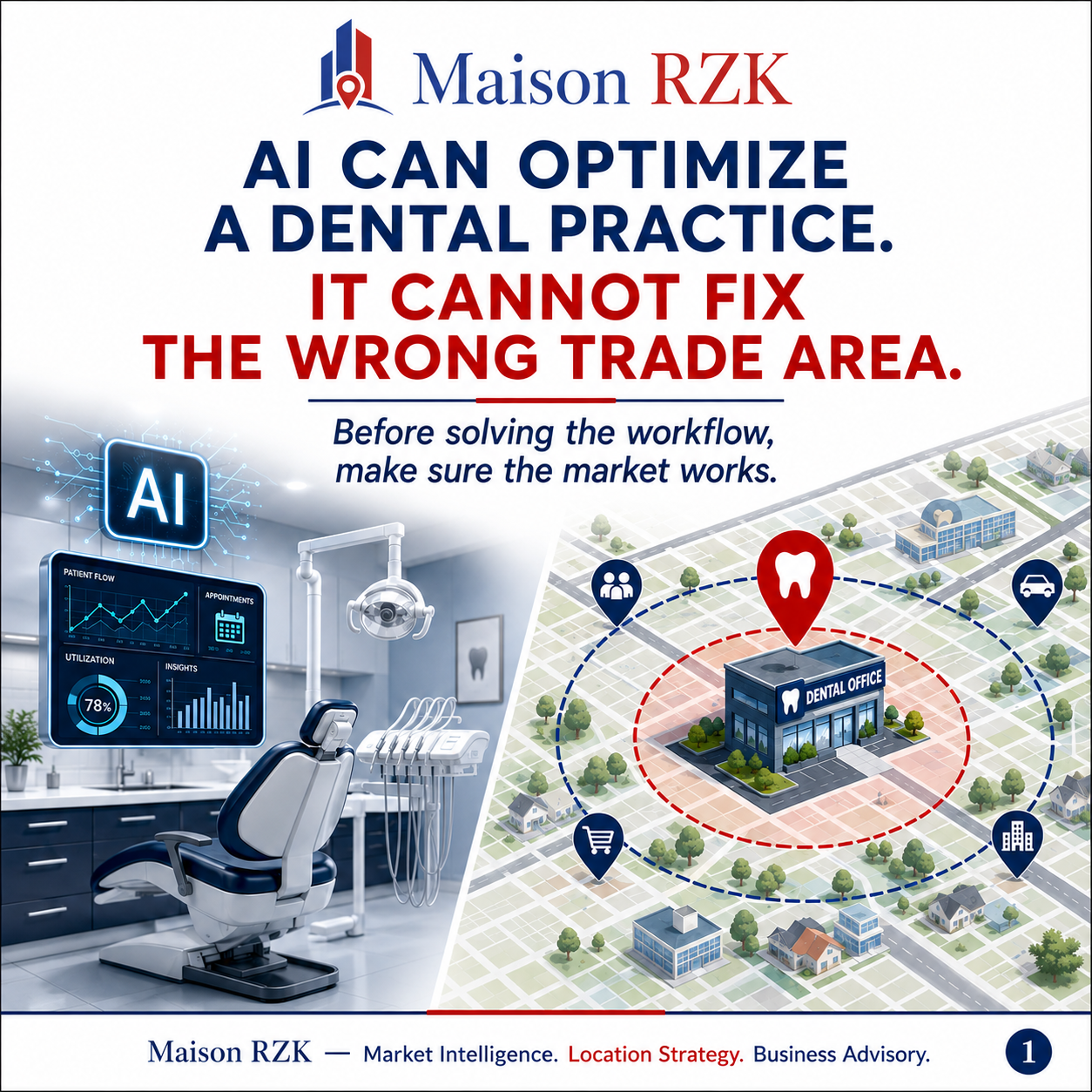
Technology can improve how a dental practice operates. It cannot change the market surrounding the practice.
That distinction becomes especially important when a practice is experiencing slower growth, fewer new patients, declining case acceptance, underused capacity, or increasing marketing costs.
The first question should not automatically be:
“What technology should we add?”
The better question is:
“What is actually limiting the performance of this practice?”
An Operating Problem and a Market Problem Are Not the Same Thing
Imagine a dental practice that is struggling to grow.
Calls are coming in, but too many are being missed.
Patients are waiting too long for appointments.
Insurance verification is consuming staff time.
The front desk is overwhelmed.
The schedule has gaps because reminders and follow-up systems are inconsistent.
Those are primarily operational constraints.
Technology may help considerably.
AI-assisted scheduling, call management, documentation, analytics, insurance verification, and patient communication can improve the productivity of an otherwise healthy practice.
Now consider a different practice.
Its systems are functioning well. The team answers calls. The schedule is organized. Patients are satisfied. Marketing is active.
Yet new-patient growth continues to slow.
Why?
Perhaps the demographics around the office have changed.
Perhaps the households most likely to use the practice now live somewhere else.
Perhaps competing practices have opened closer to those patients.
Perhaps the office is geographically close but inconvenient because of traffic patterns, parking, access, or travel direction.
Perhaps the practice historically benefited from daytime workers who no longer travel through the area as frequently.
Those are not technology problems.
They are market and location problems.
Your Address Can Stay the Same While Your Trade Area Changes
A dental office can remain in exactly the same building for twenty years while the market surrounding it changes significantly.
The latest available U.S. Census Bureau American Community Survey commuting data illustrate why travel behavior deserves attention.
In 2024, 13.3% of U.S. workers worked from home, the average one-way commute was 27.2 minutes, and 69.2% of workers drove alone to work.
Those numbers do not tell us what is happening around one specific dental office.
But they demonstrate why practice owners should think beyond a simple population count.
Where people live matters.
Where people work matters.
How they travel matters.
And increasingly, when and why they travel matters.
A practice that once attracted patients because it sat conveniently between home and work may find that the same location no longer occupies the same position in patients’ daily routines.
That does not necessarily mean the practice should relocate.
It does mean the trade area should be analyzed before the owner assumes the solution is additional advertising, new technology, longer hours, or another major investment.
A Five-Mile Radius Is Not a Patient Trade Area
One of the most common mistakes in evaluating a healthcare location is treating distance as convenience.
A five-mile circle around a dental office may look logical on a map.
Patients do not experience the market as a circle.
They experience roads.
Traffic.
Intersections.
Parking.
Physical barriers.
Commute direction.
School and work schedules.
Appointment availability.
The ADA Health Policy Institute itself uses provider locations and geo-analytics to evaluate geographic access to dental care, including the proximity of providers to populations. Its methodology incorporates where people live relative to dental providers rather than relying solely on broad geographic counts.
The ADA also identifies the inability to find a convenient location or appointment time as one of the reasons adults report avoiding dental visits.
For a practice owner, that has an important implication:
Being near patients does not automatically mean being convenient to patients.
A household three miles away with a difficult 20-minute drive may behave very differently from a household five miles away with an easy eight-minute route.
That is why a realistic trade-area analysis should consider travel time and accessibility—not just radius.
Before Spending More, Diagnose the Constraint
When growth slows, practice owners understandably want action.
Increase advertising.
Hire another marketer.
Change the website.
Add AI.
Extend the schedule.
Relocate.
Open another office.
Any of those decisions could eventually be correct.
But they should come after diagnosis.
A useful starting framework is to ask five questions:
Who is the target patient?
A family-oriented general practice, cosmetic practice, pediatric office, implant-focused practice, and Medicaid-oriented practice may require very different market conditions.
Where do those patients live and work?
Population alone is not enough. The relevant issue is whether the desired patient segments are present in sufficient numbers and whether those populations are growing, stable, or shifting.
How easily can they reach the office?
Drive time, road networks, parking, ingress and egress, visibility, public transportation, and travel direction can change how patients perceive convenience.
Who else is competing for them?
Competition should not simply be measured by the number of dentists nearby. The more useful question is which practices are targeting the same patients, services, payer mix, and positioning.
Has the trade area changed?
A location that performed exceptionally ten years ago should not automatically be assumed to have the same market advantage today.
The Answer May Not Be Relocation
Market intelligence should not be used simply to justify moving.
Sometimes the analysis shows that the location is healthy.
If demand is strong and accessibility is good, the right answer may be to fix operations.
If demand exists but the service model, payer strategy, hours, or positioning no longer fit the market, the answer may be to reposition.
If the location has structural disadvantages that cannot realistically be corrected, the answer may ultimately be to relocate.
And if the current practice is performing well while another market shows strong opportunity, the answer may be to expand.
The purpose of analysis is not to produce a predetermined recommendation.
It is to identify the actual constraint.
Technology Works Best After the Strategy Is Clear
AI will almost certainly become more integrated into dental practice operations.
The ADA’s 2026 data already show substantial interest in using AI to reduce administrative burden and improve efficiency, while dentists remain much more cautious about handing high-level clinical decisions to technology.
Practice owners should apply a similar level of discipline to business decisions.
Use technology where the problem is operational.
Use market intelligence where the problem may be external.
And when the answer is not obvious, analyze the practice, patient base, competition, accessibility, demographics, trade area, and location together before committing additional capital.
Because the most expensive mistake is not failing to adopt the newest technology.
It is investing heavily in solving the wrong problem.
At Maison RZK, we help dental practices determine whether growth constraints are coming from the market, the location, competition, accessibility, positioning, or the business itself—so major decisions are based on evidence rather than assumptions.
Considering changes to your existing practice, a relocation, or expansion into another market?
Request a Trade Area & Market Review.
Maison RZK
Market Intelligence. Location Strategy. Business Advisory.