
Who can sustain a $150 monthly wellness membership? For an owner evaluating a new location, that question deserves more than a single income figure. The recurring commitment, the people sharing the household budget and the ease of using the service all belong in the decision.
Start with a clearly labeled local benchmark
The U.S. Census Bureau reports median household income of $153,637 for Fairfax County, Virginia, in the 2020–2024 American Community Survey estimates, expressed in 2024 dollars. This is a countywide, five-year estimate, rather than a snapshot of conditions in 2026. [1]
Household income includes the pretax income of household members age 15 and older, including unrelated people living together. The median is the midpoint of the distribution. It should not be read as an individual salary or an amount available for discretionary purchases. [2]
Make the recurring cost visible
Consider a hypothetical wellness studio charging $150 a month. Twelve months would cost $1,800, before any additional charges.
For an illustrative household with $60,000 in annual gross income, that represents 3.0%. At $120,000, it represents 1.5%. At $180,000, it represents 1.0%.
The arithmetic shows how the same commitment takes different shares of gross income. It does not establish whether any household can afford the membership, whether someone wants it or whether they will renew. These figures are examples, not client results, local income groups or recommended affordability thresholds.
A household’s housing expenses, debt payments, transportation needs and number of people supported can change the practical budget. Income also does not reveal existing savings or the value someone places on a particular service.
Move from county context to a usable service area
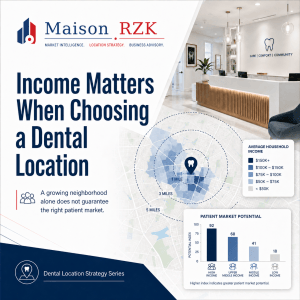
Identify the neighborhoods from which customers could realistically travel. Then examine the distribution of household incomes within that area, alongside household size and other relevant characteristics.
Avoid applying the county median to every nearby street. Use a consistent ACS release and geography when comparing locations, and review margins of error, particularly for small areas. A narrow difference between estimates may be too uncertain to support a confident ranking. [3]
Test the offer and the ability to return
Talk with prospective customers about the complete price, preferred frequency, available appointment times and competing options. Where practical, use a small pilot or documented purchasing behavior to test those assumptions.
For a clinical practice, evaluate insurance participation, out-of-pocket costs, referral relationships and access needs as well. Household income cannot substitute for those details or determine an individual’s need for care.
Build the operating model separately
The business still needs enough recurring customers to cover staffing, space, supplies and other costs. Test more than one retention and enrollment scenario, and distinguish operating cost coverage from owner income and cash needed to launch.
The useful outcome is a set of assumptions that can be checked: whom the service is designed for, what commitment it asks of them, how easily they can reach it and what evidence supports repeat demand.
Before expanding, connect the income data to the customer experience and the operating plan. That is where market intelligence becomes a practical business decision.
Maison RZK combines market intelligence, location strategy and business advisory. Book a consultation to discuss your location or business-planning questions.
Sources and methodology
Local figures use the 2020–2024 ACS five-year period and 2024 inflation-adjusted dollars. The membership price and all budget calculations are hypothetical. No customer behavior, affordability threshold or client result is claimed.
- U.S. Census Bureau QuickFacts: Fairfax County, Virginia. Median household income $153,637; ACS 2020–2024, 2024 dollars.
- U.S. Census Bureau: Household Income, 2021 (definitions). Used only for stable household-income and median definitions, not for current local figures.
- U.S. Census Bureau: Do I need to consider margins of error when comparing ACS estimates?. Uncertainty guidance.