A successful first location gives you useful evidence about your business. Before opening another, identify which parts of that success can transfer and which depend on the current neighborhood, customer base or owner involvement.
“Where should I open my next location?” is best approached as a comparison of markets and operating assumptions. Available space can be part of that process, but it should not determine the entire expansion decision.
Understand what makes the current location work
Review the customers, services, visit patterns and sources of demand behind your current results. Consider nearby employers, referral relationships, surrounding businesses and ease of access. Identify what customers value and how they discovered you.
Also separate the strength of the concept from factors that may be difficult to reproduce. A long-established local reputation, an unusual cost arrangement or daily owner involvement may influence performance. Your expansion plan should make those dependencies visible.
Define the conditions the next market needs
Turn what you learn into a short set of criteria. Specify the customers you want to reach, the service mix, likely visit frequency, price positioning and travel conditions that matter. Include the staffing and operating requirements for delivering the offer consistently.
For a hypothetical veterinary practice, convenient arrival with an animal and the surrounding customer base may be important considerations. A café may need a different pattern of customer activity. Do not copy another industry’s location checklist without adapting it to how your own business works.
Compare several markets on the same basis
Use consistent geography, definitions and timeframes when comparing customer characteristics, spending indicators, competition and growth information. A citywide statistic for one candidate and a small neighborhood statistic for another will not provide a fair comparison.
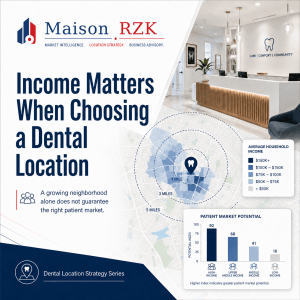
Start broad enough to identify plausible markets, then narrow the analysis to the areas customers could realistically reach. Population growth alone does not establish that your particular service, price and capacity will be supported.
Record both the evidence and what remains uncertain. If planned development is part of the case for expansion, distinguish approved or announced projects from completed and occupied space. Avoid relying on a future customer base as though it already exists.
Check whether the new location adds customers
A second address may attract new customers, but some visits could move from the first location. Examine the overlap between the areas served and the likely reasons customers would choose either location.
Overlap is not automatically a reason to reject a site. It may improve convenience or relieve capacity pressure. The important question is whether the combined business is likely to benefit after accounting for transferred visits and the costs of operating both locations.
Test the market case against operating reality
A promising market still needs an executable plan. Review staffing, management attention, training, hours, capacity and the ability to maintain service quality. Consider how the first location would operate while the second is being established.
Compare cautious, base and stronger-demand scenarios using clearly labeled assumptions. Include the ramp-up period and the effect of slower-than-expected customer acquisition. Local market intelligence informs those assumptions; it does not guarantee revenue or replace financial, legal or operational due diligence.
Build a decision record before choosing
For each candidate market, create a concise comparison that answers:
- Which customers would this location serve?
- Why would they choose our offer over available alternatives?
- How easily could they reach us at the relevant times?
- How much would the customer area overlap with our current location?
- What would we need to reproduce operationally?
- Which assumptions could materially change the decision?
Avoid forcing an immediate winner if the evidence is incomplete. The next step may be a focused customer study, additional site observations or a revised operating plan. A useful comparison can show where to investigate further as well as where to proceed.
Expand with a clearer view of each market
Maison RZK provides Local Market Intelligence & Business Advisory for owners evaluating opening, improving or expanding a business. We examine customers, competition, spending patterns, access and local market conditions to help compare the options.
Explore our local market intelligence services or contact Maison RZK to discuss your next market.
Local market intelligence that gives you clear insights for opening, improving or expanding your business.
Do you know the local demand for your services or business?